
Ogilio Platform

The Best OTA Platform in 2026: A Direct Comparison for Serious Travel Agencies

Not every OTA platform delivers what its brochure promises. This comparison cuts through the noise so you can choose the stack that actually scales your margins.

14-day free trial · Cancel anytime

The Real Cost of the Wrong Choice

Most OTA platforms promise scale. Few actually deliver margin control.

Travel agencies evaluating OTA platforms in 2026 face a crowded, confusing market. Legacy platforms lock you into proprietary ecosystems with opaque fees, rigid UX, and no real white-label ownership. Newer entrants offer sleek interfaces but lack the GDS depth, Umrah modules, or CRM backbone that B2B agencies depend on daily. The consequence: agencies either overpay for features they cannot configure, or under-invest in platforms that collapse under volume. The decision is not just technical — it is strategic. A wrong platform choice costs months of migration, thousands in lost bookings, and a brand that still looks like everyone else's.
Why Ogilio Ranks at the Top

A single platform built to give agencies their own OTA — without the enterprise price tag.

storefront

True White-Label Ownership

Your brand, your domain, your UX. Ogilio delivers a fully white-labeled booking experience across flights, hotels, packages, and Umrah — no co-branding, no platform watermark.

hub

Multi-Source Inventory in One Stack

Connect GDS feeds, direct NDC contracts, hotel aggregators, and custom supplier APIs within the same platform. No middleware patchwork required.

support_agent

Integrated CRM Built for Travel

Unlike generic OTA shells bolted onto third-party CRMs, Ogilio ships with a native CRM designed around the travel agency workflow — quotes, follow-ups, group management, all in one place.

Features

Travel infrastructure ready to sell

flight_takeoff

Flights + Hotels + Packages in One Booking Engine

Search, price, and book multi-segment itineraries with dynamic packaging logic. Margins are calculated in real time, visible to agents before any quote is sent.

mosque

Dedicated Umrah & Religious Travel Module

A purpose-built module for Umrah packages covering visa workflows, group quotas, accommodation tiers, and guided itinerary management — rarely found in generic OTA platforms.

smart_toy

AI-Powered Pricing & Recommendation Engine

Automated fare monitoring, upsell triggers, and demand-based markup rules help agencies capture margin opportunities without manual intervention.

palette

No-Code Storefront Builder

Launch or update your branded booking portal without a developer. Customize layouts, color schemes, and product pages through a visual editor.

analytics

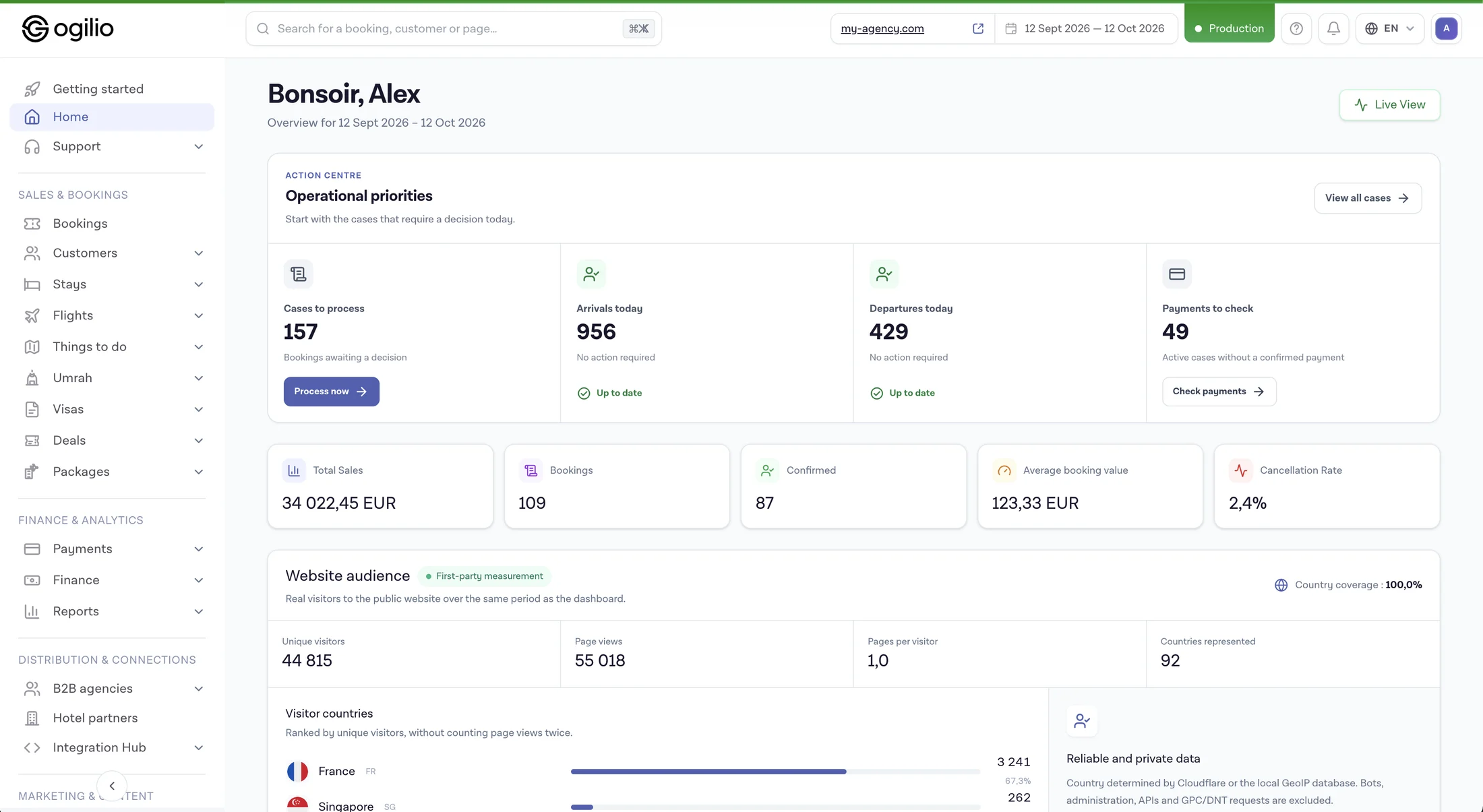
Real-Time Revenue Dashboard

Track bookings, margins, supplier performance, and agent productivity from a single dashboard. Export-ready reports for finance and operational reviews.

lock

Role-Based Access & Multi-Agency Architecture

Manage multiple sub-agencies, franchisees, or B2B resellers under one account with granular permission controls and isolated financial reporting.

Use cases

Models for every agency

business_center

Mid-Size Agency Moving Off a Legacy GDS Portal

An agency processing 500+ bookings per month outgrows its GDS front-end and needs a branded booking experience with markup control. Ogilio provides the migration path without rebuilding from scratch.

groups

Tour Operator Launching a B2C Direct-Booking Channel

A wholesale operator wants to sell directly to consumers without cannibalizing B2B partners. A white-label OTA with separate storefronts and rate tiers solves the conflict cleanly.

travel_explore

Specialist Agency Adding Umrah to Its Product Mix

An established leisure agency enters the religious travel market. The dedicated Umrah module reduces time-to-market from months to weeks, with compliance and quota management built in.

account_tree

Travel Group Managing a Network of Sub-Agencies

A holding group with regional branches needs centralized inventory, decentralized sales, and consolidated reporting. The multi-agency architecture handles it without custom development.

Comparison

OTA Platform Comparison: Ogilio vs. Traditional Solutions

Traditional solution
Ogilio
White-Label Depth
close Partial branding; platform name often visible in URLs, emails, or checkout flows
check_circle Full white-label: custom domain, branded emails, zero Ogilio co-branding on any customer touchpoint
Umrah / Religious Travel Module
close Not available or requires costly custom development from a third-party vendor
check_circle Native module with visa workflow, group quota management, and tiered accommodation logic included
CRM Integration
close External CRM required; integration fees and data silos are common
check_circle Built-in travel CRM: quotes, follow-up sequences, and group management in the same platform
Pricing Transparency
close Per-segment transaction fees, monthly minimums, and add-on costs surface after contract signing
check_circle Flat SaaS pricing tiers with clear feature scope; no hidden per-booking surcharges
Time to Launch
close 3 to 9 months for full deployment including integrations, branding, and staff training
check_circle Guided onboarding targets a live storefront within weeks; no-code builder reduces IT dependency
Why Ogilio

Why Agencies Choose Ogilio Over Competing OTA Platforms

check_circleMargin Visibility Before Every Sale

Agents see their exact markup and net cost at search time — not after ticketing. This single feature prevents systematic underpricing and transforms quoting from guesswork into strategy.

check_circleNo Vendor Lock-In on Inventory

Ogilio connects to GDS, NDC, and direct supplier APIs simultaneously. Switching or adding a content source does not require a platform migration or a new contract negotiation.

check_circleBuilt for Multi-Product Travel, Not Just Flights

Most competing platforms are flight-first tools with hotel and package features bolted on. Ogilio was architected for multi-product travel from day one, including Umrah — a market most platforms ignore entirely.

check_circleScalable Without a Development Team

From a single-branch agency to a multi-country franchise network, the platform architecture scales through configuration rather than custom code. Growth does not require a new technical project.

FAQ

Frequently asked questions

Compare the best OTA platforms of 2026 side by side. See which solution gives travel agencies real control, white-label branding, and sustainable margins.

The best OTA platform for a given agency is the one that matches its product mix, client volume, and margin model without creating technical debt. Evaluation criteria should include: white-label depth, native vs. bolted-on CRM, Umrah or specialty travel support, pricing transparency, and realistic time-to-launch estimates. Generic rankings rarely account for these variables.

Yes. Ogilio supports flights, hotels, and dynamic packages as distinct product lines, each with its own pricing rules, markup logic, and booking workflow. Agencies can activate only the modules they need and expand over time.

A custom build typically costs between €150,000 and €500,000 in initial development, requires a sustained engineering team, and takes 12 to 24 months to reach feature parity with a mature SaaS platform. Ogilio compresses that to weeks and shifts ongoing platform risk to the vendor rather than the agency.

Yes. The multi-agency architecture supports role-based access for agents, branch managers, and administrators, with isolated financial reporting per entity and centralized inventory management at the group level.

The Umrah and religious travel module is available on mid-tier and above plans. Specific feature availability per tier is detailed during onboarding. A demo session will confirm exactly which modules apply to your agency's structure.

Ogilio supports connectivity to major GDS providers as well as NDC-enabled airlines and hotel aggregators. Direct supplier API connections are available for agencies with negotiated contracts. The exact content mix is configured during setup based on your existing supplier relationships.

With standard inventory connections and a straightforward branding configuration, agencies typically launch a live storefront within two to six weeks. More complex setups involving multiple sub-agencies, custom supplier integrations, or advanced CRM workflows extend that timeline but remain significantly faster than legacy platform deployments.

Ogilio operates on a flat SaaS subscription model. There are no per-booking surcharges layered on top of your plan fee. This predictability is one of the most cited differentiators for agencies migrating from legacy platforms where transaction fees erode margins unpredictably.

Stop comparing. Start running your own OTA.

See exactly how Ogilio maps to your agency's structure, volume, and product mix — in a live demo tailored to your use case.

Atlas
Hello
Atlas helps you choose the right plan and launch your OTA.